Can you or can’t you? Where is cannabis smoking allowed in Canada?
Unfortunately, there is no one-size-fits-all rule when it comes to where people can smoke cannabis and where they can’t in Canada. To be on the right side of the law, it’s best to get familiar with the rules of the particular locale.
Where smoking or vaping cannabis is allowed in Canada varies depending on the province or territory, and also the city. With plenty of similarities and differences among the many jurisdictions, that means there’s no blanket answer that applies to all Canadians looking to consuming legal cannabis. So what may be fine and dandy for your friend living in, say, Hamilton, Ont., might not be the case for you in Canmore, Alta.
In Canada, in fact, three levels of government—federal, provincial and municipal—dictate where people can light up. That’s a lot of cooks in the kitchen. First, notes the federal Cannabis Act, a person must be 18 years to smoke legal cannabis, though every province and territory, with the exception of Quebec (as it currently stands), have raised this minimum age to 19.

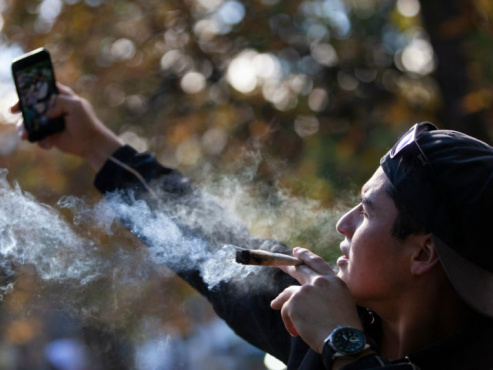
A man takes a selfie as he smokes a marijuana cigarette during a legalization party at Trinity Bellwoods Park in Toronto, on Oct. 17, 2018.
The most common place to legally smoke cannabis across the country is inside your cozy abode—that is, if you’re the homeowner. Renters, on the other hand, should not assume they’re good to go since, ultimately, that is their landlord’s decision.
Some things the same, some different about cannabis smoking rules
Consider, as an example, what rules apply in Ontario. People can legally smoke or vape inside several places. Beyond private residences, most outdoor public spaces such as parks and sidewalks are fair game from the provincial government perspective. Inside of an RV or camper van is also legal, as long as it has a kitchen and permanent bed and isn’t moving or going to move. Same goes for boats.
Ontarians of legal age can also smoke and vape in designated smoking rooms at hotels and controlled areas in some retirement homes or hospices.

Where smoking or vaping cannabis is allowed in Canada varies depending on the province or territory, and also the city.
Certain events in Ontario, like Toronto’s Craft Beer Festival, at least this year, will have designated smoking spaces where cannabis can be safely and legally consumed.
What about the places where cannabis smoking and vaping is verboten in the province? Well, there are a few: indoor common spaces, like at a university campus or in a condo building; enclosed public places, such as bus shelters and libraries; or inside hotel rooms that aren’t designated as “smoking.â€
Also on the “do not spark here†list are any public areas within 20 metres of a playground, daycare or where at-home childcare is provided. When in doubt, think of the children. No smoking or vaping within 20 metres of a public recreational facility, like a pool or a sports arena, either.
It’s also illegal to smoke near places that provide healthcare in Ontario. Nine metres from the entrance or exit of institutions like hospitals is required as is that distance if you and your joint/vape are in front of restaurant/bar entrances and patios spaces.
Most provincial laws are the same or similar to the Ontario ones outlined above. Nova Scotia has a Smoke-Free Places Act that pertains to all combustibles, including cannabis and nicotine. In Alberta, laws are similar, too, but municipally, they vary greatly. In Calgary, for example, individuals can smoke or vape inside of their homes (as the owner—rules for renters are, again, dictated by the landlord), but that’s the only place. Using recreational cannabis is illegal in all public places in Calgary.
While legal cannabis can be consumed recreationally in Canada, interestingly, some visitors have laws implemented by their home country that they must abide. The Embassy of the Republic of Korea in Canada explained on Twitter that it’s illegal for South Koreans to use cannabis, even when in a country where it’s legal. “Please take care not to commit an illegal act and be punished,†a tweet in October 2018 noted, as reported by Fortune.

While legal cannabis can be consumed recreationally in Canada, interestingly, some visitors have laws implemented by their home country that they must abide.
Like Canada itself, cannabis smoking laws are a mosaic
The take-away: there’s no blanket answer that applies to all Canadians when it comes to where a person can and cannot consume legal cannabis. The best advice is to do a quick Google search and find the local government’s website. Many medium- to large-size cities have this information posted online, while smaller towns may require a bit of digging, and you may have to contact your municipality for specific bylaw restrictions.
Â
Want to keep up to date on what’s happening in the world of cannabis?  Subscribe to the Cannabis Post newsletter for weekly insights into the industry, what insiders will be talking about and content from across the Postmedia Network.