Rosy Mondin argues legislators need to get going and fully embrace cannabis
It seems that everyone’s an “activist†these days.
Especially in the new golden age of cannabis legalization, the image of the outspoken, pot-smoker-turned-professional is an enticing one. Many cannabis CEOs, in fact, could arguably claim activist status themselves. With the stringent packaging, the hard stance on branding and thumbs-down from some municipalities, industry leaders still have to fight not to be viewed as miscreants who’ve slipped into legality on a technicality.
Â
Â
“They still treat it like toxic waste,†argues Rosy Mondin, recipient of the 2018 Canadian Cannabis Awards’ first-ever “Woman in Weed†award, criticizing what she sees as a reluctance by legislators to embrace cannabis licensing fully. “Things aren’t transitioning quickly enough,†Mondin says, suggesting that Canada’s slow retail licensing process is keeping long-time producers just outside the gates. “It shouldn’t be this difficult.â€
Mondin expects the black market to persist because of what she sees as a misstep in enforcing the transition. In her eyes, she emphasizes the government needs to be pushing licences through as fast as possible, and not relying on the hard hand of the law to bring illicit businesses into regulated territory.

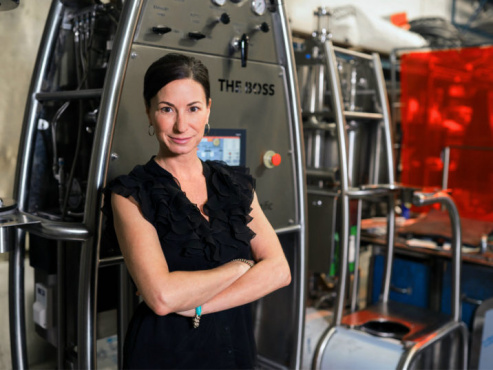
Rosy Mondin, CEO of Quadron Cannatech Corporation, stands alongside The BOSS. The BOSS combines proprietary max flow technology with advanced thermodynamics, automated features and an exclusive plug and play design. Recently updated to include a Clean-In-Place system designed for GMP standards that allow it to meet the greatest performance in terms of simplicity, innovation and quality.
Citing police raids, seizures and charges against illicit storefronts, Mondin wonders if the current approach is helping or hurting the cause. “They’ve stayed open under fear of criminality before,†she says. “Online seems to be doing well, too,†she says, adding the illicit market—which she decisively refers to as the legacy market—is “going strong.â€
Mondin sees illicit distributors’ perseverance as an indicator that many consumers aren’t getting everything they need from the federal government’s supply right now.
Voice for the defence
Since Mondin’s formative years, the lawyer-turned CEO of cannabis extraction and processing company Quadron Cannatech has been pushing back against the government’s hand-wringing with a hard stance of her own.
Looking through the lens of criminology during her time at Simon Fraser University in the early 1990s, prohibition never made sense to her. Though she’s never played defence for cannabis in the courtroom, she says she “would always be on my soapbox about why it should be legal.â€
To the amusement of her friends, she would send them studies and stories supporting her then-outrageous theories of legitimacy, outlining its history and many medical properties.
Mondin’s not shy about her use of the plant for its recreational boost, either. “I was never a drinker… cannabis was always the go-to intoxicant for me. It didn’t give me hangovers, and it didn’t hold me back the way alcohol would.†Coming from a family that pushed education, she says she could wake up clean and clear, putting her nose to the grindstone even after a nightly smoke.
After setting her sights on corporate law, Mondin dedicated much of the 2000s to a variety of entrepreneurial and legal endeavours: overseeing start-ups, acting as general counsel and occupying C-suite territory for venture capital firms and real estate agencies. It wasn’t until 2014 that her knack for policy, passion for pot, drive for enterprise and simple chance placed her at the cannabis industry’s doorstep.

Rosy Mondin and the team at Quardron Cannatech, a Vancouver-based company that operates through its vertically integrated subsidiaries, Soma Labs Scientific, Greenmantle Products and Cybernetic Control Systems.
Born and bred in Vancouver, she’d met her share of fellow enthusiasts. “I knew a lot of growers who were applying under the MMAR (Marihuana Medical Access Regulations) for licences,†recalls Mondin. “They contacted me because they were being forced into the (MMAR) program if they wanted to cultivate legally.â€
She explains that while advocacy groups spoke for dispensaries and big licensed producers (LPs), licensed personal producers were frequently absent from the conversation.
“We saw over 1,800 applicants lying in wait. It was like regulatory purgatory,†says Mondin, who founded the Cannabis Trade Alliance of Canada in 2015 to advocate for sustainability and inclusivity in the cannabis industry. The framework for legal cannabis, as she describes it, was obtuse, making it so those interested in cultivating would have to invest in full, seed-to-sale operations if they wanted to enter the space legally—not a viable option for growers who simply wanted to grow.
Mondin began advocating for greater segmentation in the legislation, an effort that eventually helped those working in the MMAR sphere to get their green on legally. After many recommendations made to legislators on her part, segmented licensing made it into the regulations that now govern the whole of the Canadian cannabis industry.
Determined to be as much an active player in the cannabis space as a voice, she founded Soma Labs Scientific in 2014, which would amalgamate to become Quadron in 2016. Extraction had caught her eye a couple years earlier when Mondin purchased some shoddy vape pens in California, turning her interest to oils rather than cultivation.
“We set up our first extraction facility under the MMAR, and it was so onerous to use,†she recalls. It took her team months to tweak the unit, but that combined effort resulted in the BOSS CO2 Extraction System that acts as the crux of the company’s extraction solutions. The group also offers set-up and oversight of their clients’ labs.
Living legacy
Mondin sees the transition from the legacy market to the legal market as the largest challenge the Canadian industry faces. “Getting the retail and distribution side of things flowing properly is important,†she emphasizes. “Keeping Health Canada’s licensing flowing nicely, having a strong seed-to-sale arrangement… the province (B.C.) is having a lot of problems,†she contends.
Referring to the legacy market in Vancouver, she says many producers and distributors have adhered to quality and production standards, but can’t hope to weather the lengthy retail licensing processes.

Rosy Mondin at a Leaf Forward event in August 2018.
She doesn’t think the country’s rulebook on cannabis is perfect either, noting that current requirements around promotion limit producers’ ability to advance their products. Mondin is concerned Canadian brands won’t be off the ground before they start importing products from international companies—which is how she expects the market will expand in the future.
“I’d like to see Canadian players start developing their brands before we start allowing cheap products from other jurisdictions.†She points again to the restrictive packaging, which some have argued gives an edge to illicit competitors.
Another issue that needs tackling revolves around medical versus recreational cannabis. Mondin thinks maintaining the distinction between medical and recreational use is crucial for sparing patients the longstanding “sin tax†applied to products like tobacco and alcohol. “There should be zero tax with medical cannabis. [Ottawa] has been talked to every which way about it,†she says.
The federal government is not budging, however, which Mondin attributes to decades of fear-mongering about the potential negative effects of cannabis use. “All mammals have endocannabinoid systems in their bodies, but we’re not being taught about them,†she laments, suggesting the Canadian Medical Association needs to prioritize better physician education on the subject.
Â
Want to keep up to date on what’s happening in the world of cannabis?  Subscribe to the Cannabis Post newsletter for weekly insights into the industry, what insiders will be talking about and content from across the Postmedia Network.