B.C.’s legal cannabis lagging in competition with ‘grey market’ marijuana
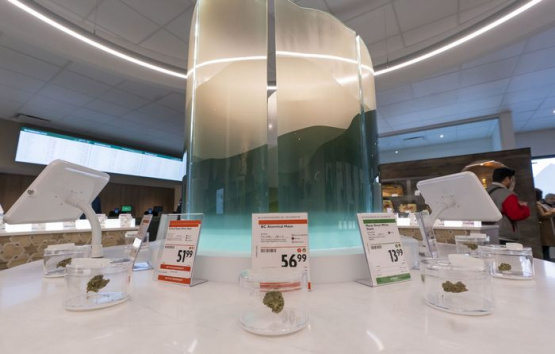
British Columbia’s early sales of legal cannabis lagged neighbouring Alberta due to a slow rollout of legitimate retail and the inability to curb the illicit market in the province, according a new research report.
B.C. rang up $19.1 million in legal cannabis sales in 2018, just seven per cent of Canada’s overall marijuana revenue, even though the province makes up nearly 14 per cent of the national population, according to an analysis by Arcview Market Research.
In Alberta, however, legal sales — both recreational and medical — added up to $216.5 million, about 28 per cent of the nation’s overall legal revenue although that province is only 12 per cent of Canada’s population.
B.C.’s robust illicit market, especially “grey-market†dispensaries, and a strong homegrown culture helps explain why “we think British Columbia may not index exactly (in line with its share of Canada’s population),†said Tom Adams, managing director and principal analyst with Colorado-based BDS Analytics, which conducted the research in conjunction with California-based Arcview.
In his report, Adams wrote that legal retail outlets at the outset of legalization constitute “a drop in the proverbial bucket compared to the hundreds of ‘grey’ market unlicensed stores,†mostly in B.C. and Ontario.
And similar to what has happened in California, Adams said the grey market will “hold back, to some degree, the legal market in that not all (illicit) operators will either get licensed or go away.â€

Arcview and BDS are more bullish about the longer-term prospects for B.C.’s market simply because “people like legal cannabis,†Adams said.
As it becomes more available, Adams said, “people will embrace the ability to go into a store and buy cannabis products legally,†especially as edibles become legal and open the market to casual consumers “who would never touch a joint.â€
B.C.’s legal cannabis market will swell to $722 million in annual sales in an overall $5.2-billion legal Canadian market by 2024, with $708 million of that coming from the recreational side, according to Arcview. But that will depend on access to product.
As of April 8, just four of 17 private licensed cannabis stores across the province were open in Metro Vancouver, all in the City of Vancouver, according to the B.C. Liquor and Cannabis Licensing Branch. Two more have had applications approved, but licenses haven’t been finalized.
Meanwhile, the City of Vancouver has identified 20 cannabis dispensaries still operating without provincial licenses, according to Kathryn Holm, the city’s chief license inspector, and are “subject to enforcement by the province’s community safety unit.â€
Holm, in an emailed response to questions, said nine of the 20 are still participating in a test case before B.C. courts.
On Dec. 13, B.C. Supreme Court Chief Justice Christopher Hinkson ordered the unlicensed shops to shut down and backed the City of Vancouver’s position that it has the authority to license and zone for the businesses.
Some of the dispensaries appealed that decision, Holm said, and “the city will await the outcome of the appeal before determining next steps.â€
The city has filed or is preparing to take legal action against the 11 dispensaries that are not part of the appeal, Holm said.
However, all the unlicensed dispensaries are feeling pressure to close, said cannabis activist Dana Larsen, who operates two of the dispensaries that are part of the appeal.
Larsen, who runs The Dispensary, with locations on Thurlow Street in the West End and on East Hastings Street, said the city has sent warning letters to his landlords about allowing the unlicensed businesses.
He estimated that about a dozen illegal dispensaries, some that were licensed under the city’s pre-legalization scheme, have closed in the last year.
In the meantime, Larsen said that the non-profit society that runs the operations has started on the legalization process and has obtained a development permit for the West End location.
But “if they gave me a permit tomorrow, I really don’t want to do that right now, because the legal system is awful,†Larsen said.
He argued that the legal system doesn’t have enough product, the prices are too high, and it doesn’t yet allow the sale of edibles and extracts that “thousands and thousands of members rely on me (for those products).â€
“I’m not willing to say no to them, but I also don’t want to be left out of the transition,†Larsen said, which he believes needs to slow down.
“I would just like to see the complainers complaining more about Health Canada and their awful roll out and complaining less about dispensaries (offering medical marijuana) currently where the government is failing to do so,†Larsen said.
twitter.com/derrickpenner